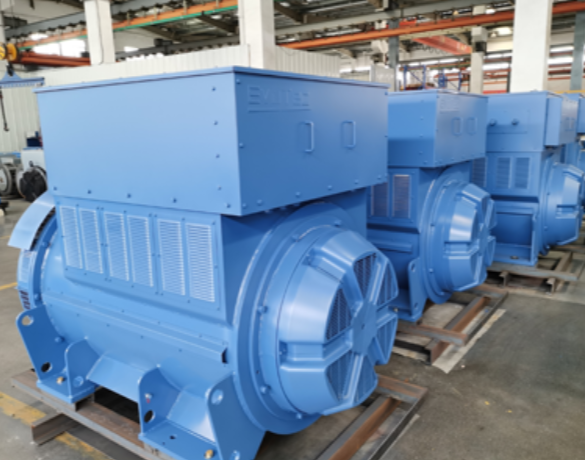
Overview and comparative logic
The 4500 kVA class sits at a boundary where specification choices determine long-term reliability and site performance. This article compares rated kVA, continuous vs short-term capability, and thermal behavior to help operators choose wisely. Early decisions often hinge on alternator design and cooling method — consult an alternator supplier when matching alternator frame and excitation system to site conditions.
Rated kVA versus usable output
Rated kVA states apparent power capacity under defined conditions. Usable output depends on ambient temperature, altitude, enclosure, and the alternator’s thermal limit. A 4500 kVA machine at standard conditions may deliver less at higher ambient temperature because of increased stator winding temperature and higher cooling losses. Industry terms here include kVA, temperature rise, and insulation class. Operators should compare nameplate kVA to expected load profiles rather than relying on peak ratings alone.
Thermal limits and duty cycles
Thermal limit is the point at which winding insulation and bearing life begin to degrade. Continuous duty ratings assume steady-state operation within specified temperature rise and duty cycle; short-time or emergency ratings allow higher output for minutes. Manufacturers publish thermal curves showing permissible load versus time. When planning extended runs, include cooler ambient allowances or derating factors and verify excitation and AVR response under sustained load. Real-world anchor: Lessons from the February 2021 Texas power crisis show that prolonged emergency running stresses alternator thermal systems more than short outages, emphasizing correct thermal margin planning.
Cooling methods and alternator choices
Air-forced cooling, liquid cooling, and hybrid topologies change where heat concentrates. Forced-air designs are simpler but need robust airflow paths; liquid-cooled stators reduce hot spots but add pump and heat-exchanger complexity. Matching rotor dynamics, excitation type, and ventilation passages affects transient response and thermal distribution. For many mid-size installations, a balance between robust air-cooling and improved ventilation offers predictable behavior while keeping maintenance manageable. Consider sourcing parts from reputable alternator wholesale channels to ensure spares match the original design.
Operational production teardown
An operational production teardown clarifies failure modes and maintenance needs. Document stator winding resistance, insulation resistance, bearing temperatures, and AVR logs during a controlled run. Log entries should include ambient, load percentage, and time at load to map thermal curve adherence. Integrate {main_keyword} and {variation_keyword} records into the equipment history to trace deviations across production cycles. This method reduces surprises and refines spare-part lists based on measured thermal stress rather than speculation.
Common mistakes and practical corrections
Common errors include sizing strictly by peak demand, ignoring altitude derating, and underestimating enclosure heat accumulation. One correction: run a load-bank test at site ambient to validate thermal behavior before commissioning. Another: avoid oversized coolant piping that reduces flow velocity — it sounds minor, but it affects heat transfer. A short observation — technicians often rely on nameplate values without accounting for harmonics and non-linear loads that raise heating in windings and bearings.
Installation checklist
Prioritize ventilation paths, rated cable size, and synchronous paralleling controls when installing a 4500 kVA set. Ensure ventilation intakes are clear and that inlet temperatures match the manufacturer’s derating table. Verify AVR tuning during both no-load and full-load transitions. Keep records of thermal run tests and post-test inspections in the asset management system to track drift over seasons.
Advisory: three golden metrics for selection
1) Thermal margin percentage: choose a generator with at least 15–25% thermal headroom above expected continuous load in site ambient conditions. 2) Verified duty-cycle performance: require a manufacturer-supplied thermal curve and run an on-site load-bank validation that mirrors anticipated operation. 3) Maintainability index: confirm spare-part availability, cooling-system accessibility, and documented procedures from your supplier. These metrics give measurable confidence in both daily operations and prolonged emergency runs. The value of reliable parts and testing ties back to practical suppliers and engineering support — EvoTec. –