Problem statement: diagnostic gap between operations and safety
Public transit systems face a diagnostic gap: operational telemetry exists but actionable safety signals are intermittent and poorly synchronized. Fleet managers perform triage on millions of data points—GPS traces, controller area network (CAN) messages, passenger counts—yet visual context is often absent. Deploying an AI dashcam supplies the missing clinical view; operators in London have reported using video-assisted event review to reduce ambiguous incident coding. The challenge is precise: convert multichannel sensor noise into validated, timestamped clinical events that guide interventions.
Core terminology clinicians must use consistently
– Incident: a discrete, timestamped event requiring investigation (collision, near-miss, sudden deceleration). – Sensitivity: the proportion of true incidents detected by a device. – Specificity: the proportion of non-incidents correctly ignored. – Event marker: a system-generated flag tied to a timestamp and source (video, GPS, CAN). – Chain of custody: immutable record linking raw sensor data to reviewed evidence. – Route adherence: deviation from scheduled geometry measured in meters and seconds. Precise definitions prevent diagnostic drift between operations, safety, and legal teams.
Diagnostics: data streams, synchronization, and indicators
Effective diagnosis requires synchronous data. Key streams and their technical constraints: GPS — position with horizontal dilution and epoch time; CAN bus — sub-second vehicle-state telemetries (brake pressure, throttle); video — frame rate, exposure, and codec latency. Evaluate indicators by measurement properties: sampling frequency, timestamp precision, and clock drift. Monitor these diagnostics continuously: missing frames, GPS leap seconds, or CAN message loss are early markers of degraded diagnostic fidelity.
Interventions: device-level solutions and workflow integration
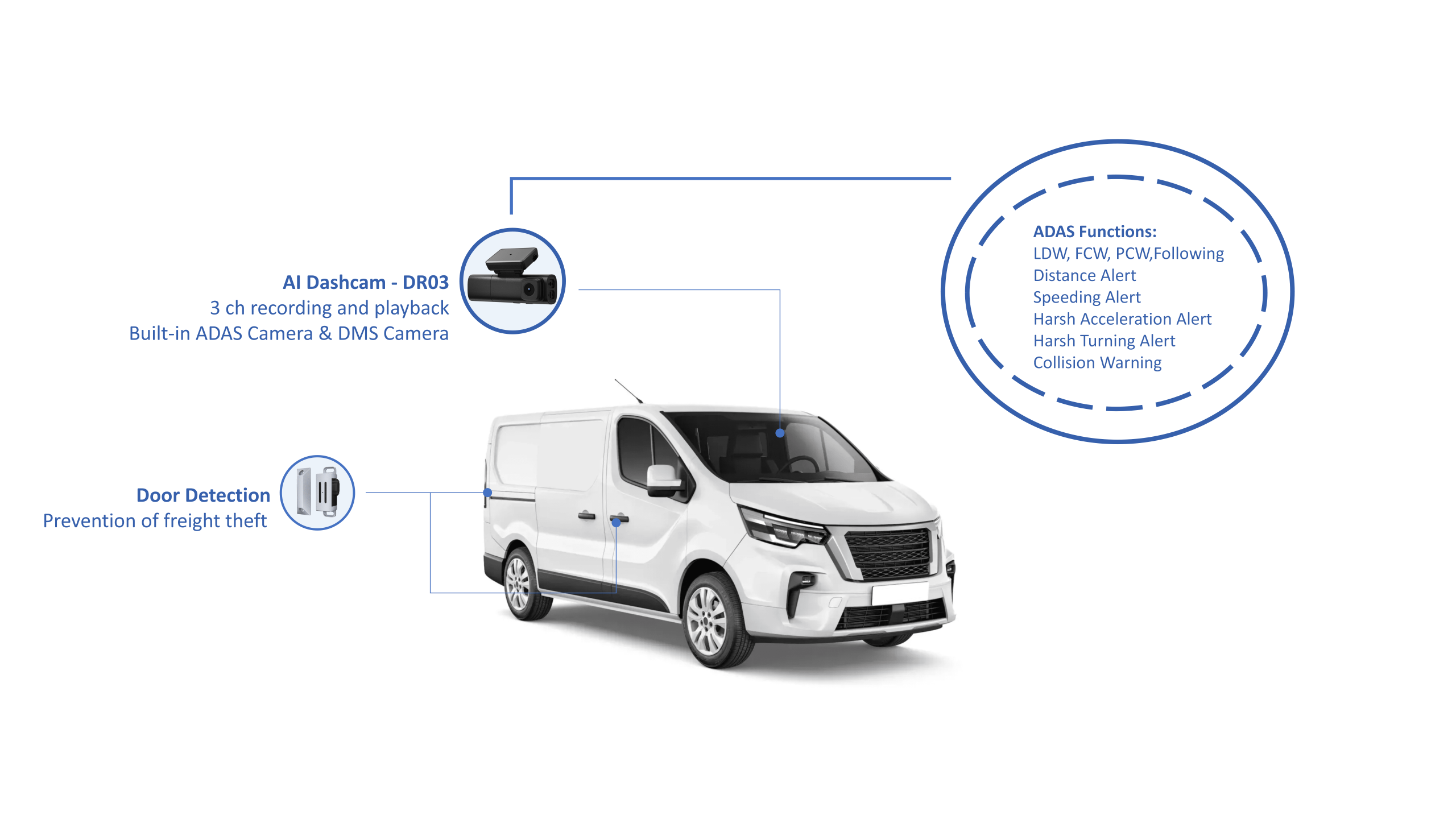
Interventions must address detection, verification, and documentation. An AI dashcam with gps tracking performs three functions: automated inference (object and event detection), geospatial anchoring (lat/long per event), and evidentiary export (signed video segments). Integrate exports with incident management protocols: automated event packets should include synchronized CAN snapshots, GPS coordinates, and a checksum for chain of custody. Apply clinical thresholds for escalation: examples — deceleration > 4 m/s² plus object intrusion within 1.5 m triggers immediate safety review; single-frame anomalies below threshold enter probabilistic review queue.
Common implementation pitfalls and corrective actions
– Clock drift between devices: implement periodic Network Time Protocol (NTP) resynchronization and record offset metadata. – False positives from shadows/reflections: train models on site-specific datasets and validate sensitivity/specificity on held-out runs. – Bandwidth constraints for high-resolution uploads: use event-driven upload windows and edge compression with lossless headers for evidentiary segments. – Privacy and regulation: redact audio or blur faces in stored exports by default, keep retention windows documented and auditable. Address each pitfall with a measurable protocol and a verification metric.
Comparative device brief: clinical metrics to compare
Compare candidates using objective clinical metrics rather than vendor rhetoric: detection latency (ms), GPS horizontal accuracy (meters at 95th percentile), event validation rate (true positives / flagged events), onboard storage endurance (hours of continuous high-resolution recording), and API completeness for automated export. Rank devices against operational thresholds: e.g., latency < 300 ms for near-miss workflows; GPS accuracy < 3 m for precise stop-line enforcement.
Synthesis: recommended diagnostic pathway and organizational alignment
Begin with a diagnostic baseline: quantify current incident capture sensitivity and specificity. Implement a phased deployment of camera-enabled diagnostic nodes, validate model performance on live routes, and codify escalation rules into operations manuals. Align legal, safety, and engineering teams around a single event taxonomy to prevent annotation inconsistency. Field experience shows steady reductions in ambiguous incident classifications when technical protocols are enforced and reviewed regularly. For a practical, device-focused foundation that preserves evidentiary integrity while fitting transit operational constraints, consider system-level vendors that document synchronization, export, and retention protocols clearly—such specification is central to the operational value identified by BSJ.