The problem: inconsistent product quality when scaling batches
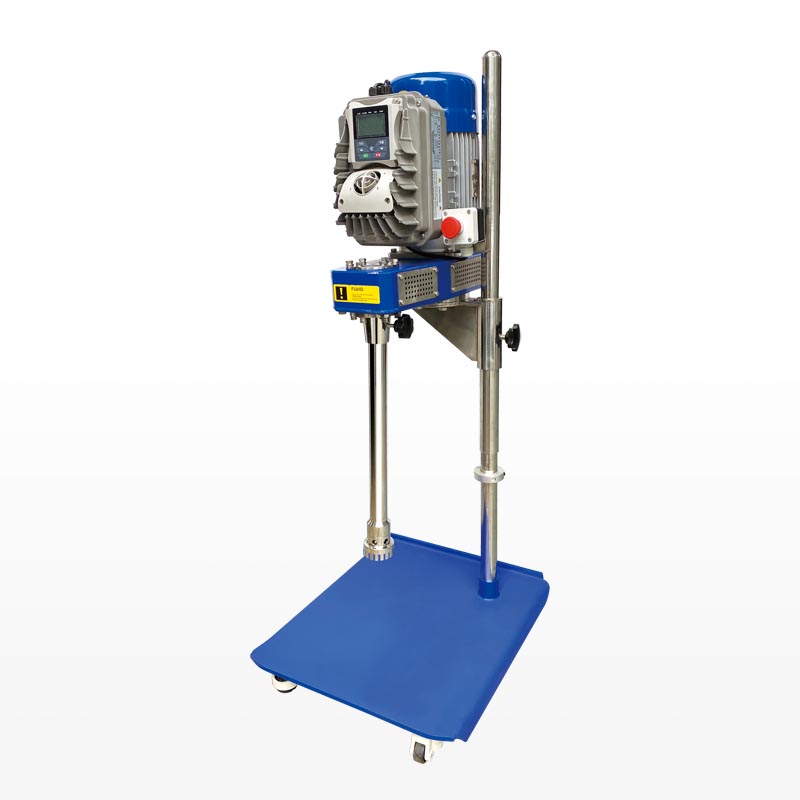
Production teams hit a wall when formulations that behave in a lab don’t behave the same in production: droplet sizes shift, suspensions settle, and viscosity curves change. The core failure is uncontrolled shear and poor geometry match between scales — not just more power. That’s why engineers standardize on controlled rotor-stator systems and modern high shear batch mixers early in process design: they let you define shear profile and reproduce it across volumes.
Where things break: the technical drivers of variability
Shear rate, energy per unit volume, particle residence time, and heat generation determine dispersion and emulsification outcomes. Small changes in impeller clearance, feed point, or cycle time multiply into big product differences. Addressing these requires measurable parameters: specify target D50 droplet size, peak shear limits for fragile APIs, and power-to-volume ratios so the mixer delivers a repeatable hydrodynamic environment instead of ad hoc stirring.
Design principles that scale
Start by mapping the mixing objective to a mechanical solution: rotor‑stator for rapid dispersion, high-torque propellers for high-viscosity masses, inline homogenizers for continuous shear. Match materials and seals to GMP or corrosive-media needs. Design the control stack to log torque, rpm, and temperature; treat those signals like metrics in a distributed system — traceable and versioned. Modular skid units and interchangeable heads let you scale capacity without requalifying core hydrodynamics.
Common mistakes and how to avoid them
People over-spec power and under-spec instrumentation. Over-shearing sensitive components ruins active ingredients; under-shearing leaves agglomerates. Feeding solids at the wrong point creates lumps or air entrainment. Neglecting CIP access adds unseen downtime. Mitigate by defining an operating envelope, running scale-down verification tests, and instrumenting for shear proxies (torque, pressure drop) so operators can keep the process inside validated boundaries.
Alternatives and trade-offs
Inline high-shear units can cut cycle time and reduce footprint, but they add piping complexity and may require recirculation. Planetary mixers handle ultra-high viscosity but deliver different shear spectra. Static mixers are simple and low-maintenance but need sufficient pressure and give limited control over droplet break-up. Choose by matching the required mechanism of dispersion: break-up by shear versus by elongational flow versus bulk kneading.
Experience and a real-world anchor
I’ve coordinated scale-up projects with formulation and automation teams across manufacturing hubs and trade shows that set industry expectations; teams presenting validated scale-up cases at CPhI Worldwide repeatedly emphasize consistent shear control as the critical factor—those teams routinely specify robust batch mixer machine when the product depends on droplet distribution or solid dispersion. That operational history, combined with field validation and traceable test reports, is what separates plausible specs from ones that survive full production runs.
Practical checklist before you buy or scale
Define measurable output (particle size distribution, viscosity curve). Run scale-down tests to reproduce the shear environment. Specify materials, seals, and CIP requirements up front. Instrument torque and temperature and log them to a historian for change control. Choose modular heads or inline options so mechanical changes don’t force full rework. Schedule maintenance intervals based on actual duty cycles, not conservative guesses.
Conclusion
When the problem is repeatability, solve it with controlled shear, measurable metrics, and modular hardware that fits your process constraints; that practical approach yields predictable scale-up and fewer surprises on the line, a goal many engineers reach by partnering with suppliers who deliver tested shear profiles and service models like FLUKO.